
What are the effects of red wavelengths on plants?

At LEDWisdom, we believe all growers should be knowledgeable about LEDs that produce light in the most widely marketed red wavelengths in the horticultural lighting market. In this article, we will discuss experiments conducted by Michigan State University testing the effects of different red wavelengths on plants and the results obtained.
In the first of a series of experiments, researchers examined how plants responded to the addition of red light at different wavelengths, while maintaining constant amounts of blue and green light. Red is considered the most efficient light for photosynthesis, but there are different shades of red light. It was not known before the experiment whether using these different shades, alone or in combination, would benefit the plants.
Tomato "Early Girl", marigold "Deep Orange", petunia "Wave Pink", and henna flower "SuperElfin XP Red" were grown under six different lighting spectra for 31 to 45 days under 160 µmol∙m∙2∙s∙1 PPFD light. Orange (596 nm), red (635 nm), and deep red (665 nm) were prescribed with percentages of 0-80-0, 0-60-20, 0-40-40, 20-30-30, 0-20-60, and 0-0-80, respectively. Plants were given 10 percent blue and 10 percent green light in all treatments.
Overall, plants grown under different colors of red light grew similarly. Fresh and dry weight, seedling height, and leaf number were generally the same. Edema or swelling was observed in tomatoes in all treatments, particularly along the veins of the seedling leaves. This has been previously reported for tomatoes and several other species in the nightshade family when sufficient blue or UV light was not provided. Marigolds developed purple spots in all treatments. 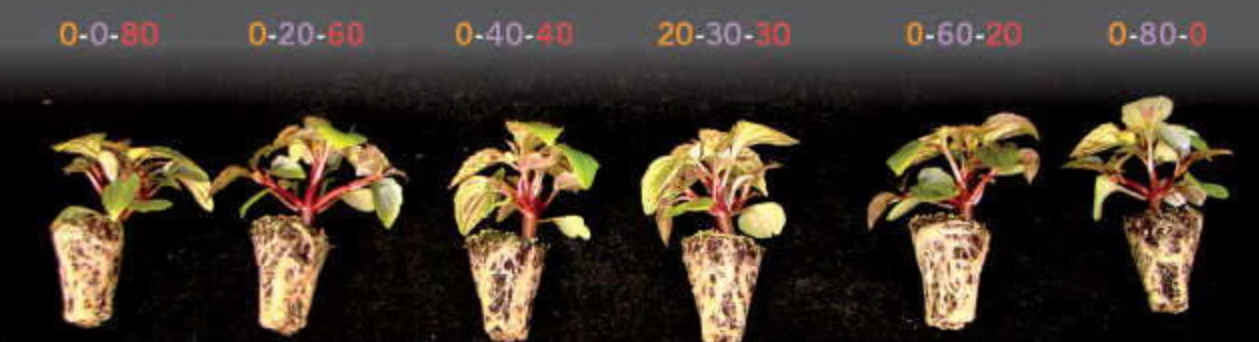
In applications with the same light intensity but different percentages of orange, red, and deep red light from the LEDs, the henna flower "SuperElfin XP Red" exhibited similar properties after 43 days at 68° Fahrenheit. All applications also utilized 10% blue light and 10% green light.
Since plants grow similarly under different shades of red light, and the wavelength of red LEDs used in the design of a grow light will not affect plant quality, the wavelength of the LED to be used should be determined based on other factors such as the LED's lifespan, efficiency, and cost. 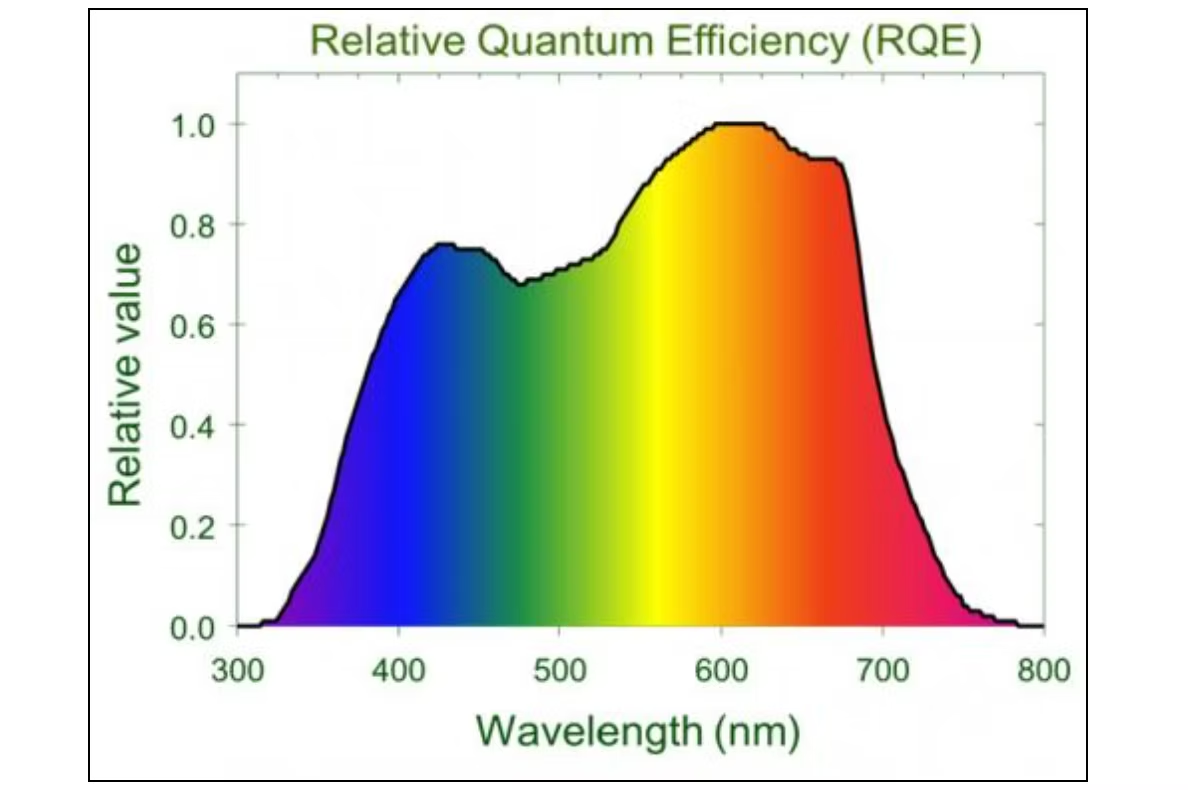
Relative quantum efficiency curve. (Adapted by Erik Runkle from McCree, 1972. Agric. Meteorology 9: 191-216.)
At LEDWisdom, we power our full-spectrum grow lights with deep red (or hyper red), the wavelength most efficiently used in photosynthesis. You can trust the LEDWisdom formula to achieve the highest efficiency in all your agricultural applications. Having a grow light with many wavelengths and a colorful appearance isn't enough to achieve the highest quality and most efficient results. Through our research and development, we have combined full-spectrum and deep red LEDs with the most suitable circuit and product design to create the WB150-R, the most efficient grow light you can achieve. and WB340-R We manufacture plant grow lights. Contact us to discover our different and most efficient designs tailored to your specific application.
References;
1- Heidi Wollaeger, M., & Erik Runkle, M. (2018, September 25). Green light: Is it important for plant growth? Retrieved October 25, 2020, from https://www.canr.msu.edu/news/green_light_is_it_important_for_plant_growth
2- McCree, KJ (1972) The Action Spectrum, Absorptance and Quantum Yield of Photosynthesis in Crop Plants. Agricultural Meteorology, 9, 191-216.
3- Runkle, H., Sofia Flores | Rosanna Freyre | Paul Fisher, Wright, J., Fisher, |., Gallagher, A., Heidi Lindberg ([email protected]) is a former graduate research assistant and now educator with Michigan State University (MSU) Extension. See all author stories here., . . . Says:, B. (2016, August 26). Growing Seedlings Under LEDs: Part Two. Retrieved October 25, 2020, from https://www.greenhousegrower.com/production/plant-culture/growing-seedlings-under-leds-part-two/